 |
Engineering -- an endless frontier | ||||||||||||
| home | engineering | branches | engineer | R&D | history | technology | controversy | bibliography | |||||
| productive capacity evolution innovation products risk | |||||||||||||
|
Engineering -- an endless frontier | ||||||||||||
| home | engineering | branches | engineer | R&D | history | technology | controversy | bibliography | |||||
| productive capacity evolution innovation products risk | |||||||||||||
| Technology as a scientific capacity of production |
| Society's technological capacity has four major repositories: people including scientists, engineers, skillful workers, and tech-savvy consumers; systematic knowledge and tacit know-how; tools, gadgets, and communication, transportation, and other physical infrastructures; education, R&D, and other social institutions. They are products of technological activities plowed back as social investment, which would be wasted if plants are allowed to stand idle and techies be underemployed. To develop and fully use its technological capacity is crucial for a society's prosperity. | 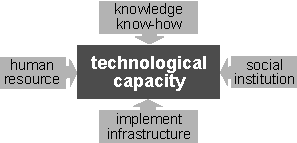 |
|
| The notion of technology as a scientific
capacity to produce, which has its root in Greek philosophical
exposition of téchnē, is discussed in Engineering -- An
Endless Frontier, section 2.1. This note fills in some
historical development of the notion.
Aristotle defined: “Téchnē (art) is a state of capacity to produce with a true logos (course of reasoning).”[1] The ancient Greeks often discussed epistēmē (narrowly science and broadly knowledge in general) and téchnē together, just as we now talk about science and technology.[2] Aristotle named them as two of the major human rational faculties that produced knowledge, the third being ethical judgment. He explained in length that because of its reasoning, art was distinct from mere experience. Men of experience made things but could not explain why they succeeded in so doing; artists could. Several points stand out in Aristotle’s analysis of art. First, as the mental capacity underlying productive activities, art has equal status as theoretical and ethical thinking, differing from them mainly in subject matter. Social discrimination of topics does not imply that productive thinking is inferior in intellectual quality. Second, art is different from mere empiricism, which I assume would include mere cut-and-try. Accounting for advancement in the state of knowledge, Aristotle’s “men of experience” seems descriptive of our artisans while his “artists” capable of giving correct material, structural, dynamic, and functional explanations of their works are close to our engineers. Third, art has its correct reasoning and not merely arbitrary opinions, and there is no argument against its incorporation of knowledge from natural science or ethics required for its reasoning. Fourth, because of its articulated reasoning, art can be taught. Aristotle would not be surprised by the rise of university education on engineering and technology. Concatenations of téchnē and logos appeared in Latin writings with ambiguous meanings. According to the Oxford English Dictionary, the etymology of "technology" is systematic treatment. As such it can be viewed internally or externally. In the external view, technology means the systematic discourse about practical art. It is the science of practical art just as geology is the science of Earth and entomology of insects. Here logos belongs to scholars who takes practical art and artists as their topics of investigation but is foreign to and not a part of the art or artists. It neglects the cognitive ability of the artists and concentrates on their products and social status. Appeared in the sixteenth century -- French rhetorician Peter Ramus used technologia for systematic arrangement of all arts -- this sense is mostly outdated. Today scholarly discourses about practical art or engineering are called not technology but technology studies, which include history, philosophy, and sociology of technology. Nevertheless, technology studies have a tendency to perpetuate the external stance of seeing technology mainly as mindless physical or social systems. In many studies, technology is drained of science, engineering, and intellectual contents. Scientists and engineers are treated on the same status as catalysts and scallops in the “actor-network model,” one of the most influential sociological models in science and technology studies. The internal view inherits the Greek notion of téchnē containing its own logos, so that technology means the systematic reasoning of practical art itself. In this view, art and reasoning are not separate entities that later enter into a marriage. They are intertwined cognitive potentials inherent in every human being, because living in, coping with, and modifying the real world is primordial to all human life. Technology is the explicit rendition of reasoning inherent in practical art; the systematic abstraction of essentials; the articulation, generalization, refinement, and development of knowledge involved in productive and creative activities. Thus practical art -- engineering and technology -- became scientific not by imitation but by self development. This view was expressed by Galileo in Two New Sciences, one of his two major books: "in this department [the Venetian arsenal] all types of instruments and machines are constantly being constructed by many artisans, among whom there must be some who, partly by inherited experience and partly by their own observations, have become highly expert and clever in explanation.”[3] Some seventeenth-century puritan theologians argued that what was nature to us was God’s creation. Therefore they rejected the Aristotelian distinction between natural science and productive art and proposed technologia that encompassed both. Among the puritans was William Ames, whose ideas were influential in Massachusetts.[4] In 1829, Boston botanist Jacob Bigelow observed that the word "technology," found in some old dictionaries, was revived among practical men. He delivered a series of lectures entitled Elements of Technology, in which gave a definition with Aristotelian ring: Technology is “the principle, processes, and nomenclatures of the more conspicuous arts, particularly those which involve application of science.”[5] He later sat on the board of trustees of Massachusetts Institute of Technology, the foundation of which in 1861 publicized the concept of technology. The internal view of technology spread in the nineteenth century. It has two connotations. In the broad sense, favored by anthropologists and historians, technology embraces all practical arts primitive and sophisticated. In a narrower sense, favored by engineers and scientists, technology includes only those practical arts that incorporate a significant body of explicitly articulated knowledge and explanation that is scientific in the modern sense. Both internalist senses were used by Karl Marx, the first great economist to expound the deep relation between modes of production and human welfare. He wrote: “Technology reveals the active relation of man to nature, the direct process of the production of his life, and thereby it also lays bare the process of the production of the social relations of his life, and of the mental conceptions that flow from those relations.” Containing man’s relations both to nature and society and incorporating all skills and knowledge about material creation and production, technology in this sense has a very broad scope. However, Marx also observed that “right down to the eighteenth century, the different trades were called ‘mysteries.’” Then, he continued, the veil of mystery was torn apart by “the modern science of technology.”[6] In this narrowed-down sense, technology is the science in which practical artists articulate and explain their own work. Both the broad and narrow meanings of technology are currently used. For instance, the five-volume A History of Technology covers practical arts since antiquity, but its editors observe that “not until the nineteenth century did the term [technology] acquire a scientific content and come ultimately to be regarded as almost synonymous with ‘applied science.’”[7] This intrinsic relationship between technology and applied science is challenged by some externalist scholars who regard applied science as intellectually inferior. Notes
|